If I had a nickel for every time I heard someone describe polyamory as "dating on hard mode" or "advanced dating," I’d probably have enough to buy a very large, very inclusive pizza for a whole polycule.
On the surface, it makes sense why people use those terms. If dating one person is a 101-level course, then dating three must be a Ph.D. program, right? But here’s the thing: calling polyamory "advanced dating" is like calling a marathon "advanced walking." Sure, they both involve moving your legs, but the preparation, the mindset, and the structural toll are completely different beasts.
As a trans-identified therapist and co-founder of a trans-led practice, I’ve spent a lot of time navigating the "in-between" spaces of identity. At Byrnes Counseling Group, we don’t just look at relationships through a clinical lens; we look at them through the lens of lived experience. We know that for many in the LGBTQ+ and ENM (Ethical Non-Monogamy) communities, polyamory isn't just a hobby or a "phase" of dating, it’s a core part of how we build family and community.
So, let’s bust some myths and talk about why polyamory is its own unique architecture, not just a busier version of the standard dating scene.
It’s Not Just About the Numbers; It’s About the Structure
When people think of "dating," they usually think of the "getting to know you" phase. It’s light, it’s exploratory, and usually, the goal is to find the one so you can stop dating.
Polyamory isn't a search for an exit strategy. It’s the intentional construction of multiple, simultaneous, committed relationships. In the poly world, we don't just "date around." We build structures.
Think about the "math" of a triad. If three people are in a relationship together, most outsiders think, "Oh, that’s one relationship with three people." Nope. A triad actually consists of seven distinct relationships:
- Person A + Person B
- Person B + Person C
- Person A + Person C
- The group dynamic of A + B + C
- Person A’s relationship with themselves
- Person B’s relationship with themselves
- Person C’s relationship with themselves
When you view it that way, you realize this isn't "advanced dating": it’s complex systems management. It requires a level of intentionality that "dating" rarely touches. You aren't just looking for someone who likes the same movies; you’re looking for someone whose presence integrates into (or respectfully parallels) an entire ecosystem.

Commitment vs. "Keeping Your Options Open"
One of the biggest myths I encounter as an identity-affirming therapist is the idea that poly people are just "afraid of commitment."
Actually, I’d argue that polyamorous folks are obsessed with commitment. We just don't think commitment has to be exclusive to be valid. In many ways, polyamory requires more commitment than monogamy. Why? Because you can’t rely on "the rules" to do the heavy lifting for you.
In a monogamous relationship, the "rules" are often a default: don't sleep with others, don't go on dates, spend your holidays together. In polyamory, every single boundary has to be negotiated and re-negotiated. There is no "autopilot." You are constantly committing to the work of communication, the work of processing jealousy, and the work of navigating relationship transitions.
The Reality of "Calendar Tetris"
Let’s get real for a second: the most "advanced" part of polyamory isn't the sex: it’s the Google Calendar.
When you are "dating," you might see someone once or twice a week. When you are polyamorous, you are managing the needs, schedules, and emotional capacities of multiple humans. This is where the "light" vibe of dating usually dies and the "labor" of relationship maintenance begins.
It’s about knowing that your Tuesday partner needs extra support because they have a big work presentation, while your Friday partner is celebrating an anniversary with their other partner (your metamour), and you need to figure out if you’re doing "Kitchen Table Poly" (everyone hanging out) or "Parallel Poly" (everyone staying separate) that night.

This level of coordination requires a high degree of emotional intelligence and self-regulation. It’s why so many of us end up in therapy: not because the relationships are "broken," but because we want to make sure we’re showing up as our best selves for everyone involved.
Why Lived Experience Matters in Therapy
As a trans-led practice, we get it. We know that when you walk into a therapy room, you don’t want to spend the first three sessions explaining what a "metamour" is or defending your right to have more than one partner. You shouldn't have to "educate" your therapist while you’re paying them to help you.
In my office (and the offices of my colleagues here), we lead with an affirming, kink-aware approach. We know that your identity and your relationship structure are intertwined. Whether you’re dealing with "new relationship energy" (NRE) or trying to figure out how to come out to your family as poly, we speak the language.
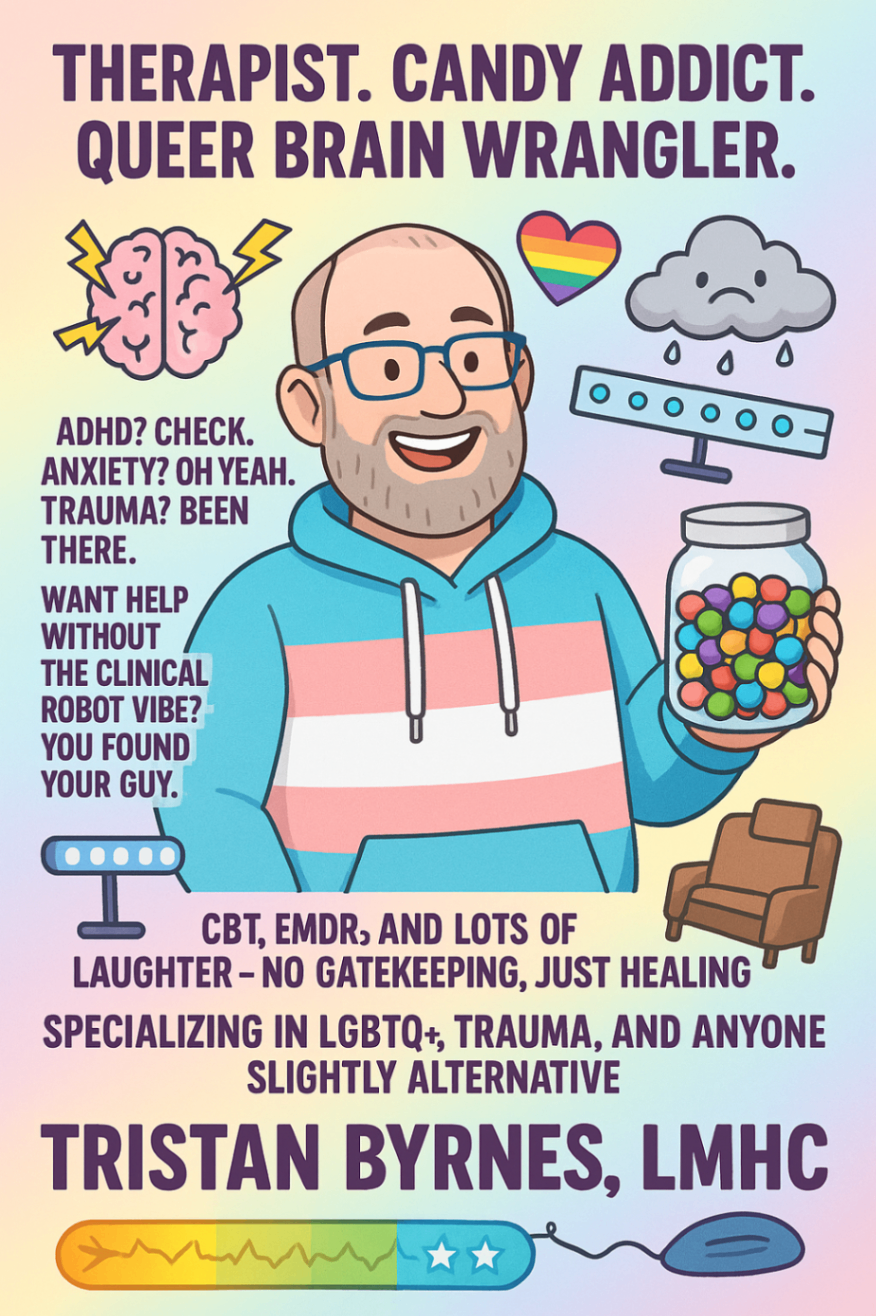
I personally love working with folks who are "doing the work." There’s a certain radical honesty that comes with the poly community. When you stop following the "standard" script of how life and love are supposed to look, you open up a lot of room for growth: but you also open up some unique challenges.
Deconstructing the "Standard" Relationship Escalator
Standard dating usually follows the "Relationship Escalator":
- Meet -> Date -> Define the Relationship -> Move in -> Marriage -> Kids -> Death.
If you step off the escalator, people think you’re just "playing around." But polyamory allows us to build "Relationship Orbits." Maybe one partner is a nesting partner (you live together), another is a long-distance anchor partner, and another is a casual but consistent connection. None of these are "lesser than"; they are just different.
Breaking free from the escalator is a huge part of identity shifts and life transitions. It’s about asking, "What does my version of happiness look like?" rather than "What does society expect me to do next?"
Finding a Polyamory Affirming Therapist
If you’ve been feeling like your relationship dynamics are "too much" for traditional therapy, or if you’re tired of the "well, maybe you just haven't found the right person yet" comments, it might be time to find a polyamory affirming therapist.
At Byrnes Counseling Group, we create a space where you can be messy, be curious, and be authentically you. We aren't here to tell you how to "fix" your polyamory; we’re here to help you navigate it with confidence and joy.
Whether you’re a seasoned "pro" at ENM or you’re just starting to dip your toes into the world of non-monogamy, remember: it’s okay to be a beginner. It’s okay to have questions. And it’s definitely okay to need a little help managing the "math" of it all.

Final Thoughts: The Joy of the "More"
Polyamory isn't just "advanced dating" because it isn't about the act of dating: it’s about the philosophy of abundance. It’s the belief that love isn't a finite resource, and that our capacity to care for one another can expand to fit the lives we choose to build. And that abundance isn't just emotional; it also means making room for a real diversity of bodies, attractions, and ways of showing up in relationships. Polyamory doesn't belong only to people who fit narrow beauty standards. Our communities are fuller, kinder, and more honest when bodies of all sizes are welcomed as desirable, worthy, and fully part of the picture.
Is it work? Absolutely. Is it more than just "dating around"? You bet. But for many of us, the work is what makes the connections so deeply rewarding.
If you’re ready to dive deeper into your own journey, whether that involves polyamory, kink, or navigating your identity as an LGBTQ+ adult, we’re here for you. You don't have to carry this alone. Let’s talk about the structures you’re building and how we can help them stay strong, healthy, and: most importantly: affirming.
Stay curious, stay honest, and maybe… check your Google Calendar.
: Tristan Byrnes, Co-founder & VP, Byrnes Counseling Group