Let’s be real for a second: "Awareness" is a bit of a low bar, isn’t it?
Every year, various months roll around where the world is told to be "aware" of us. It’s like we’re the subject of a high-budget nature documentary. “Look at the neurodivergent adult in their natural habitat, attempting to navigate a grocery store while the fluorescent lights scream at them. Fascinating.”
While being seen is better than being invisible, awareness usually stops at the "noticing" phase. It’s passive. It’s the world acknowledging that we exist, usually with a side of "thoughts and prayers" or a puzzle piece (don't even get me started on the puzzle piece).
Here at Byrnes Counseling Group, we’re officially over just being "aware." We’re moving into the era of Acceptance and Celebration. If you’re a neurodivergent adult, this week is for you. We’re kicking off "The Authenticity Toolkit" week, and today, we’re shifting the focus from how the world sees us to how we celebrate our own magnificent, "spicy" brains.
Awareness is the Floor, Not the Ceiling
Awareness is knowing that neurodivergence exists. Acceptance is knowing that neurodivergence is a valid, beautiful, and permanent part of the human experience. Celebration is when we stop trying to "fix" our brains and start building a life that actually fits them.
For a long time, the clinical world looked at ADHD, Autism, and other neuro-types through a "deficit" lens. If you didn’t process information like a neurotypical person, you were "broken." The goal of therapy was often to mask: to learn how to act "normal" enough so that other people wouldn't feel uncomfortable.
As a trans-led practice, we know a thing or two about the pressure to mask. We know what it feels like to be told that your core identity is a "problem" to be managed. But guess what? Your brain isn't a problem. The way you process the world: the deep dives, the pattern recognition, the sensory intensity: is part of your identity. Identity-affirming therapy isn't about teaching you how to hide; it’s about teaching you how to thrive as your unfiltered self.

Shifting from "Noticing" to "Celebrating"
When we talk about celebrating our brains, we aren't being toxic-positive. We know that living in a world built for neurotypical people can be exhausting. Executive dysfunction is real. Sensory overload is real. Burnout is very real.
But celebration happens when we stop apologizing for those things.
Instead of saying, "I'm sorry I'm so sensitive to noise," celebration sounds like, "I have an incredible ability to notice details others miss, so I’m going to wear my noise-canceling headphones to protect my energy."
It’s shifting the narrative from being "more than just lazy" to recognizing that your brain simply has a different operating system. If you’ve spent years feeling like you’re failing at life because you can't keep a planner, check out our post on why neurodivergent adults deserve better support. It’s not a lack of will; it’s a lack of appropriate tools.
The Trans-Led Perspective: Why Lived Experience Matters
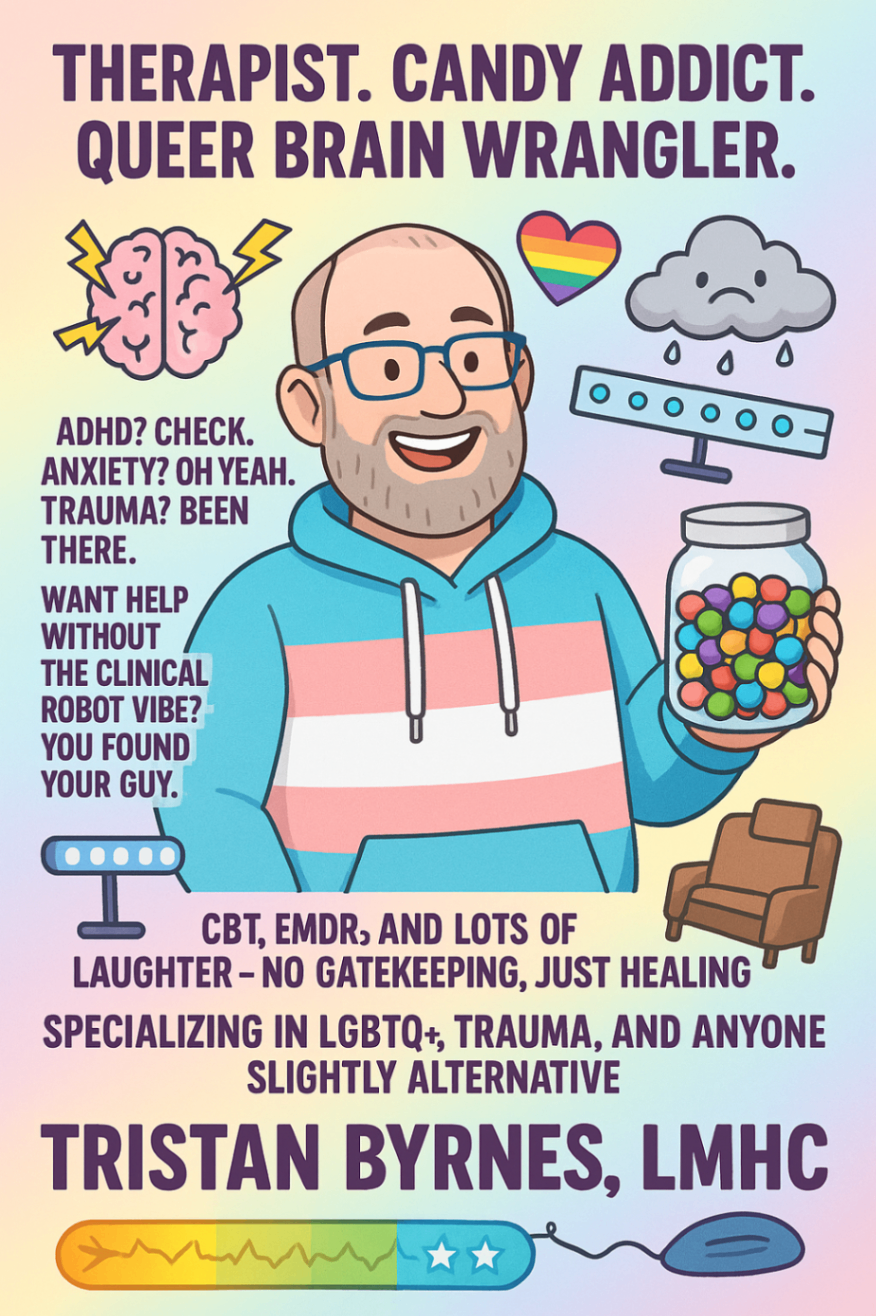
I’m Tristan, and I’m a trans-identified therapist. Why does that matter for a neurodiversity blog post? Because the Venn diagram of the LGBTQ+ community and the neurodivergent community is basically a circle. Many of us are navigating the world with "double" or "triple" layers of being "different."
When you walk into a therapy room, you shouldn't have to explain the basics of your existence. You shouldn't have to teach your therapist what "stimming" is or why your gender identity feels tied to your neurotype. At Byrnes Counseling Group, we lead with lived experience. We aren't just clinical observers; we are in the community.
We understand the specific ways that neurodivergence impacts communication in queer spaces. There is an unspoken language that happens when you don't have to "perform" neurotypical social cues. That is the kind of safety we strive to create here. When we say we offer identity-affirming care, we mean we see the whole you: the queer you, the trans you, the neuro-spicy you: and we think that version of you is the one worth keeping.
The Radical Act of Self-Acceptance
So, how do we actually move toward celebration? It starts with a radical act: Stopping the mask.
For many neurodivergent adults, masking is a survival mechanism. It’s the armor we put on to avoid being judged, fired, or rejected. But wearing armor 24/7 is heavy. It leads to a specific kind of soul-crushing fatigue.
Acceptance means looking at that armor and saying, "Thank you for keeping me safe, but I’m ready to breathe now." It means:
- Allowing yourself to fidget or stim because it helps you focus.
- Advocating for your sensory needs without guilt.
- Rejecting the idea that "productivity" is the only measure of your worth.
- Finding a community that speaks your brain’s language.

In my work, I see so many clients who have spent decades trying to "fix" themselves, only to realize that the "broken" parts were actually just the most interesting parts of their personality. When we stop fighting our biology, we free up an incredible amount of energy for creativity, connection, and joy.
Finding the Right Support
If you’ve felt like you’ve been "on trial" your whole life: trying to justify why you do things differently: therapy can be the place where you finally get to rest. But it has to be the right kind of therapy.
We’ve all had those experiences with "traditional" counselors who suggest we just "try harder" or "get a better calendar." Facepalm. If that worked, we would have done it twenty years ago!
Lived experience matters in therapy. You deserve a therapist who knows that your "hyperfocus" is a superpower, not a symptom to be suppressed. You deserve a space where your neurodivergence is celebrated as a part of your identity, not a diagnosis to be managed.

What’s Next for The Authenticity Toolkit?
Today is just the beginning. We’re moving from awareness to acceptance, but the journey doesn't stop there. Over the next few days, we’re going to dive deeper into the practicalities of being neurodivergent in a world that isn't always kind to us:
- Tuesday: We’re tackling the "Explanation Trap." Spoiler alert: You don't owe the world a simplified definition of who you are.
- Wednesday: We’re holding space for the "Lost Years": the time we spent hiding before we knew better.
- Thursday: Practical Neuro-Joy! We’re talking sensory safety and low-demand living.
- Friday: We’re wrapping up with "Resilience in the Mosaic," looking at how our community’s determination keeps us going, especially right here in Florida.
Your brain is a custom-built, one-of-a-kind instrument. It might not play the same tunes as everyone else’s, but that’s because it was meant for a different symphony.
If you’re ready to stop "managing" your brain and start celebrating it, we’re here to help. You don't have to carry the weight of masking alone. Whether you’re navigating a late-in-life diagnosis or just looking for a therapist who truly "gets" the intersection of LGBTQ+ identity and neurodivergence, we’ve got your back.
Let’s move past awareness. Let’s get to the good stuff. Welcome to the celebration.