If you have spent any amount of time in the “productivity” corner of the internet, you’ve probably felt like a complete failure. You know the drill: the 5:00 AM cold plunges, the color-coded planners that cost $40 and end up as expensive coasters, and the grueling "grind mindset" that promises if you just try harder, you’ll finally become a functional adult.
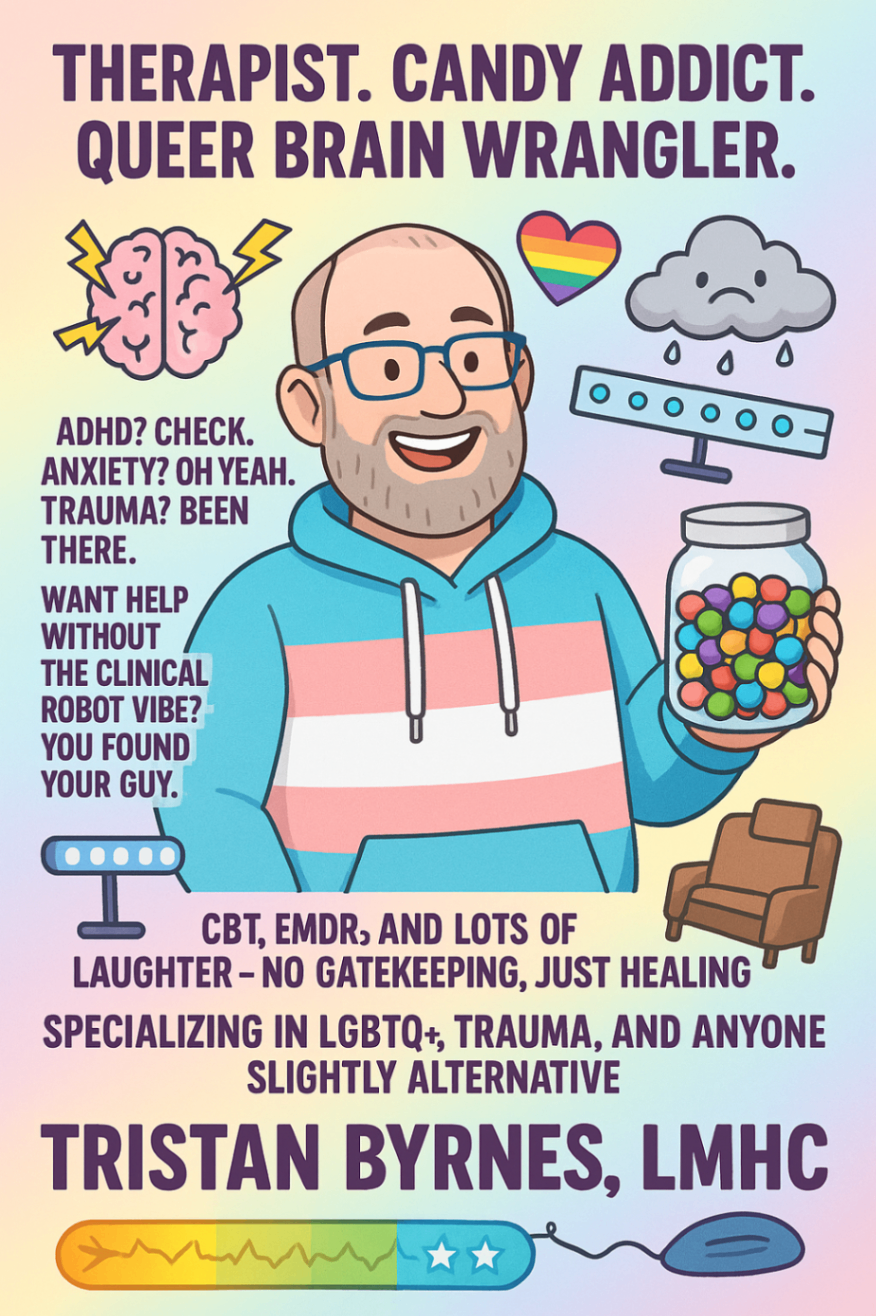
As a trans-led practice here at Byrnes Counseling Group, we’re calling a timeout. Most of that advice is built for neurotypical brains: brains that have a steady, reliable stream of dopamine. For those of us who are neurodivergent adults, our brains work a little differently. We aren’t "lazy," we don't have a "character flaw," and we certainly don't need another lecture on discipline.
We need dopamine. Specifically, we need to stop fighting our brain's natural chemistry and start working with it.
The ADHD Stigma and the "Lazy" Trap
The ADHD stigma is heavy. From a young age, many of us were told we weren’t living up to our potential. We were told to "just sit still" or "just focus." When you carry that baggage into adulthood, it turns into a nasty inner critic that screams "lazy" every time you can’t bring yourself to do the dishes or respond to an email.
But here’s the clinical truth wrapped in a casual reality: Executive function is like the project manager of your brain. In neurotypical folks, the project manager has a full staff and a steady budget (dopamine). In our brains, the project manager is underfunded, the staff is on strike, and the lights keep flickering.
When we talk about "productivity," we aren’t talking about becoming corporate robots. We’re talking about finding ways to live your life without the constant weight of shame. We’re talking about moving from awareness to acceptance and celebrating how your brain actually functions.
The Science of the "Spark"
Dopamine isn’t just the "reward" chemical; it’s the "motivation" molecule. It’s the spark that helps you transition from "thinking about doing the thing" to actually "doing the thing." For neurodivergent adults, the baseline of dopamine is often lower. This means "boring" tasks (like taxes, laundry, or administrative work) don't provide enough neurological "spark" to get the engine turning.
Instead of trying to force the engine to turn with sheer willpower: which is exhausting and leads to burnout: we can use "dopamine-friendly" hacks to grease the wheels.

Strategy 1: The "Dopamenu" (Dopamine Menu)
Think of a "Dopamenu" as a pre-written list of activities that actually nourish your brain. When we hit a wall and feel understimulated, our instinct is often to "doom-scroll" for three hours. It gives us tiny hits of dopamine, but it leaves us feeling like garbage.
A Dopamenu gives you better options. Break it down like a real menu:
- Appetizers (5-10 mins): Quick hits like putting on a favorite song, doing a quick stretch, or petting your dog.
- Entrees (30-60 mins): Deeply engaging activities like a hobby, a walk in nature, or a creative project.
- Sides (Passive): Things you do while doing something boring. This is where "Side Dishes" come in: listening to a specific podcast only while you fold laundry, or using a fidget toy during a long meeting.
- Desserts (Indulgent): These are great, but don’t over-rely on them. Video games, social media, or a TV binge.
By having this list written down (and posted somewhere visible, because out of sight = out of mind), you take the "thinking" out of the equation when your brain is already fried.
Strategy 2: Body Doubling (Community is a Tool)
There is something almost magical about "Body Doubling." It’s the practice of having another human being in the room (or on a video call) while you do a task. They don't even have to help you. They just have to be there.
For many of us in the LGBTQ+ and neurodivergent community, isolation is a real struggle. Body doubling taps into our social brains. It provides a gentle layer of external accountability that makes it easier to stay on task. At Byrnes Counseling Group, we often talk about how resilience is a team sport. Your productivity doesn't have to be a solo mission.

Strategy 3: Low-Shame "Side Dishes" and Sensory Safety
Traditional productivity says "eliminate distractions." We say: "Add the right distractions."
If your environment is sensory-hell, your executive function is going to tank. If the lights are too bright, your clothes are itchy, or the room is too quiet, your brain is using all its energy just to cope with the environment. There’s nothing left for the actual task.
We advocate for finding sensory safety. This might mean:
- Wearing noise-canceling headphones.
- Working in a "nest" of pillows.
- Using a weighted lap pad.
- Keeping "stims" or fidgets at your desk.
In our office, we lean into this hard. You’ll see fidget toys, comfortable seating, and a vibe that says "come as you are." We don't care if you need to pace while we talk or if you can't make eye contact because you're focusing on a Rubik's cube. That's not a distraction; that's regulation.

Strategy 4: The Intersection of Neuro-Spicy and Gender-Spicy
As a trans-identified therapist, I see the overlap between neurodivergence and gender identity every single day. There is a specific kind of exhaustion that comes from navigating a world that wasn't built for your brain or your body.
When you’re dealing with gender dysphoria or the stress of navigating a binary world, your executive function takes a hit. You’re already using 40% of your brain power just to exist safely in public. When you add ADHD or autism into the mix, it’s a lot to carry.
That’s why our approach is always affirming. We want to help you break the explanation trap. You don’t have to justify why you do things differently. If you need to keep your socks on to feel grounded, or if you need to use a text-to-speech app because reading is overwhelming today, do it. Your identity and your neurobiology are intertwined, and both deserve respect.
Strategy 5: Body Neutrality in Productivity
Let’s talk about the physical side of "getting things done." Often, productivity culture is linked to "wellness" culture, which can be incredibly fat-phobic and shaming. You’re told that to be productive, you must have a certain kind of body or eat a certain kind of "clean" diet.
We reject that entirely. Whether it's movement as joy or simply finding a way to feed yourself that doesn't feel like a chore, your body size has nothing to do with your worth or your ability to function. If "productivity" for you today looks like ordering delivery because the executive function to cook isn't there, that is a valid win. We are a fat-positive therapy office, and we believe that being kind to your body is the first step in being kind to your brain.
Practical Tips for the "Rest of Us"
If you’re feeling stuck right now, here are a few witty, low-stakes things to try:
- The "Just One Minute" Rule: Tell yourself you will only do the task for 60 seconds. Usually, the hardest part is the transition. Once you’re in it, the dopamine might kick in. If it doesn't? Stop after a minute. You kept your promise to yourself.
- Gamify the Boring Stuff: Use an app like Habitica or just set a timer and see if you can "beat" the clock.
- The "Junkyard" To-Do List: Write everything down on a piece of scrap paper. Don't organize it. Don't make it pretty. Just get it out of your head so your brain stops trying to remember it.
- Forgive the "Lost Years": If you were diagnosed late in life, you might be grieving the lost years. That’s okay. Productivity starts with self-compassion.
You Are Not Broken
The biggest hack for executive function isn't a planner or a Chrome extension. It’s the radical realization that you are not broken. You are a neurodivergent adult living in a world designed for a different operating system.
At Byrnes Counseling Group, we’re here to help you navigate those "glitches" without the shame. Whether we're working through trauma with EMDR therapy or just helping you figure out how to navigate a life transition, we do it with a sense of humor and a lot of heart.
You don’t have to carry the weight of "shoulds" anymore. Let's find the "coulds" that actually feel good.