
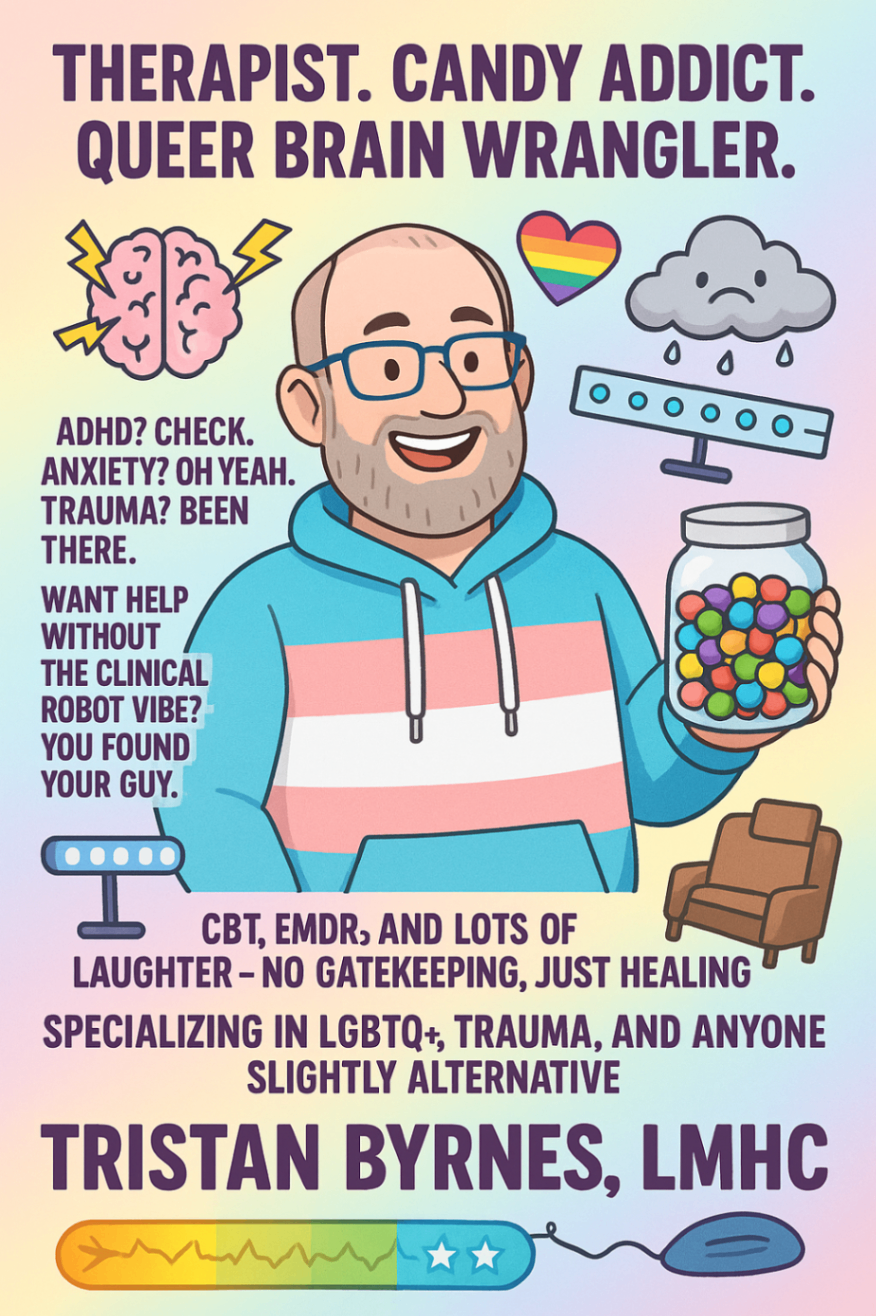
Let me tell you something wild: I'm 54 years old, I've been a licensed mental health counselor for years, and I just got diagnosed with ADHD last year.
Yeah. Last year. At 54.
And honestly? It explains so much. The way my brain has always worked, the struggles I chalked up to anxiety or just… well, me, the coping mechanisms I built without even realizing I was compensating for something. Turns out there was a name for all of it, I just never got the memo because the mental health system wasn't really designed with people like us in mind.
If you're a queer adult who's wondered whether you might have ADHD, or if you've recently gotten that late-in-life diagnosis and you're still processing it, this one's for you. Let's talk about why so many of us slip through the cracks, and more importantly, what you can do about it now.
Why Queer Adults Get Overlooked
Here's the thing: ADHD doesn't care about your age, gender, or sexuality. But the systems designed to diagnose it? They've historically been built around a very specific image of what ADHD "looks like", and spoiler alert, it's usually a hyperactive 8-year-old boy bouncing off the walls in a classroom.
If that doesn't sound like your experience, welcome to the club. Pull up a chair. (Just don't expect me to sit still in mine.)
1. Your Symptoms Got Blamed on Being Queer
This one hits close to home. How many times have healthcare providers looked at a queer person struggling with focus, anxiety, or emotional regulation and thought, "Well, they're dealing with identity stuff, that must be the problem"?
Too many times. Way too many.
When you don't fit society's expectations, there's this annoying tendency for clinicians to attribute everything to your queerness. Struggling at work? Must be the stress of being trans. Can't maintain relationships? Probably because of discrimination. Meanwhile, ADHD is sitting there in the corner, waving its arms, completely ignored.
2. Gendered Diagnostic Biases Are Real
The research on ADHD was built predominantly around cisgender men and boys. Women, non-binary folks, and trans individuals? We present differently. Our ADHD might look like daydreaming instead of hyperactivity. It might show up as perfectionism, people-pleasing, or anxiety rather than the "classic" signs.
When you add the complexity of gender identity on top of that, the diagnostic picture gets even muddier. Clinicians who aren't trained to see beyond the stereotypes simply… don't.
3. You Became a Professional Masker
Here's where it gets really interesting. As queer people, many of us learned to mask from a young age. We learned to hide parts of ourselves, to read social situations carefully, to adapt and perform in ways that kept us safe.
Guess what? That same masking skill set can hide ADHD symptoms beautifully.
You've probably gotten really good at appearing organized (even when your brain is chaos), seeming attentive (while internally you're on thought number 47), and covering up the ways you're struggling. The problem is, when you're that good at masking, clinicians don't see anything to diagnose.

4. Healthcare Access? What Healthcare Access?
Let's be real: accessing quality healthcare as an LGBTQ+ person is often an uphill battle. Between financial barriers, discrimination, and the general lack of providers who actually understand our experiences, many of us avoid the healthcare system altogether.
And if you can't get in the door, you can't get diagnosed. Simple as that.
For those of us in Florida, the current political climate hasn't exactly made things easier. If you're struggling with how Florida's anti-LGBTQ+ laws are affecting your mental health, you're definitely not alone, and seeking any kind of healthcare becomes one more thing on the overwhelming pile.
5. Your Providers Didn't Know What They Were Looking At
Cultural competence matters. A lot.
Many clinicians simply haven't been trained to recognize how ADHD shows up in marginalized populations. They might be perfectly nice people with good intentions, but if they've never considered how queerness and neurodivergence intersect, they're going to miss things.
As a trans-identified therapist myself, I've seen firsthand how much difference it makes when your provider actually gets it. When someone understands your lived experience, they're better equipped to see the full picture of what's going on.
6. The Stress of Being Queer Covered Everything Up
Living in a world that wasn't designed for you is exhausting. The constant social pressure, the stigma, the effort of navigating spaces where you might not be safe or welcome, all of that creates stress. A lot of stress.
And that stress? It can look a whole lot like ADHD. Difficulty concentrating, emotional dysregulation, anxiety, feeling overwhelmed, these are symptoms of both. When you're drowning in minority stress, it's incredibly hard to separate "this is how my brain is wired" from "this is my response to an exhausting world."
7. You Didn't Fit Neatly Into Any Box
Here's the kicker: even within communities that should understand us, intersectional folks often struggle to find our place. Neurodivergent spaces don't always center queer experiences. LGBTQ+ spaces don't always understand neurodivergence.
When you're living at the intersection of multiple identities, getting validation, let alone a diagnosis, becomes that much harder. You might have spent years wondering if your struggles were "real enough" to warrant investigation.
(Spoiler: they were. They are.)

Okay, So What Now?
If you're reading this and thinking, "Well, that explains a few decades of my life," I hear you. Getting diagnosed later in life brings up a lot of feelings, grief for the younger you who struggled without support, relief at finally having answers, maybe some anger at the systems that failed you.
All of those feelings are valid. Give yourself space to feel them.
But here's the good news: it's never too late. Here's what you can do:
Find affirming providers. Look for clinicians who understand both LGBTQ+ experiences and neurodivergence. They exist, I promise. (Hi, hello, that's literally what we do here.) A provider who gets it won't make you explain your identity before you can even get to the ADHD conversation.
Reframe your story. Those things you've been beating yourself up about for years? The forgetfulness, the emotional intensity, the rejection sensitivity? That might not be a character flaw. That might be your brain working differently. Understanding ADHD as part of your neurodiversity can be incredibly freeing.
Be explicit about everything. When you're seeking assessment or treatment, bring your whole self to the table. Talk about your queer identity AND your concerns about ADHD. Help your provider connect the dots instead of assuming one explains the other.
Find your people. Neuroqueer community is a beautiful thing. Connecting with others who share both identities can provide validation, resources, and the kind of "oh my god, you too?!" moments that remind you that you're not alone.
Advocate for yourself. Standard ADHD assessments might not capture your experience. Ask for comprehensive evaluation that takes masking and identity stress into account. You deserve an assessment that actually sees you.
Late Diagnosis Isn't the End, It's a Beginning
Look, I won't pretend that getting diagnosed at 54 hasn't been a lot to process. There's definitely been some "what if I'd known sooner?" moments. But mostly? Mostly it's been clarifying. Empowering, even.
Understanding how my brain works has helped me be gentler with myself. It's helped me build better systems, ask for what I need, and stop wondering why certain things have always felt so hard.
If you're on this journey, whether you're questioning, newly diagnosed, or still trying to figure out where to start, know that you're not broken. You're not "too much" or "not enough." Your brain just works differently, and there's nothing wrong with that.
And hey, if you want to talk about it with someone who genuinely gets it? Reach out. We're here.